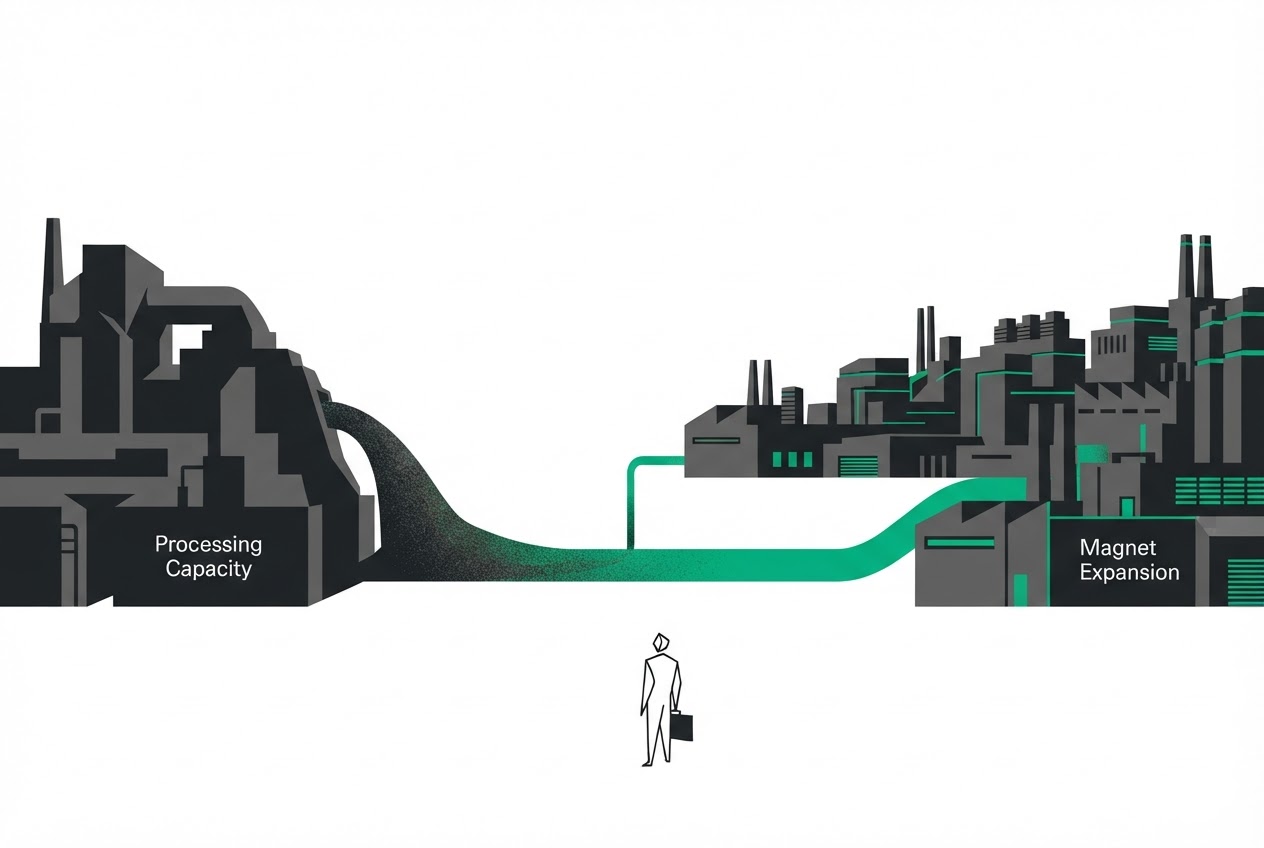
A shortage of rare earth metal and alloy production outside China could constrain Western magnet manufacturing expansion, OilPrice.com reports, citing forecasts from Canaccord Genuity. The supply gap is already reflected in sharp price differences: samarium sells in North America for as much as 346 times its Chinese price, while dysprosium costs five times as much outside China and yttrium more than 100 times as much.
The bottleneck lies between mining and magnet production. Rare earth oxides must be converted into metals, combined with other materials and cast into alloy strips before they can feed magnet factories. According to Canaccord figures cited by OilPrice.com, China controls more than 90% of the world's 210,000 tonnes of capacity for this processing stage. Equipment constraints compound the problem: strip casters can take up to two years to arrive, and the bank's checks found Chinese purchases blocked by current export controls.
Canaccord forecasts that magnet manufacturing capacity outside China will more than triple to about 70,000 tonnes by 2030. Metal and alloy capacity outside the country is projected to reach only 38,000 tonnes, leaving producers dependent on Chinese supplies or competing for scarce alternatives. OilPrice.com also reports that US manufacturers purchase about 48,000 tonnes of rare earth magnets annually, against domestic production of just 300 tonnes in 2025.
Washington has sought to shield domestic producers from Chinese price competition. Under a 10-year agreement with MP Materials, the Pentagon guarantees a minimum NdPr price of $110 per kilogram, covering the difference when benchmark prices fall below that threshold. That support addresses price risk, but does not itself resolve the processing shortfall.
REalloys operates a metals, alloys and magnet materials facility in Euclid, Ohio, and says it has North America's only operating heavy rare earth metallisation capability. OilPrice.com reports that the company has secured rights to approximately 80% of the Saskatchewan Research Council's expanded output. Under a Defense Logistics Agency contract, it is also designing a facility capable of producing 300 tonnes annually of samarium and gadolinium metal.
The longer-term outlook points to continuing pressure. The International Energy Agency projects a 50% rise in demand for magnet rare earths outside China by 2035 and warns that processing and magnet capacity there will remain substantially insufficient even if every announced project proceeds, according to OilPrice.com.