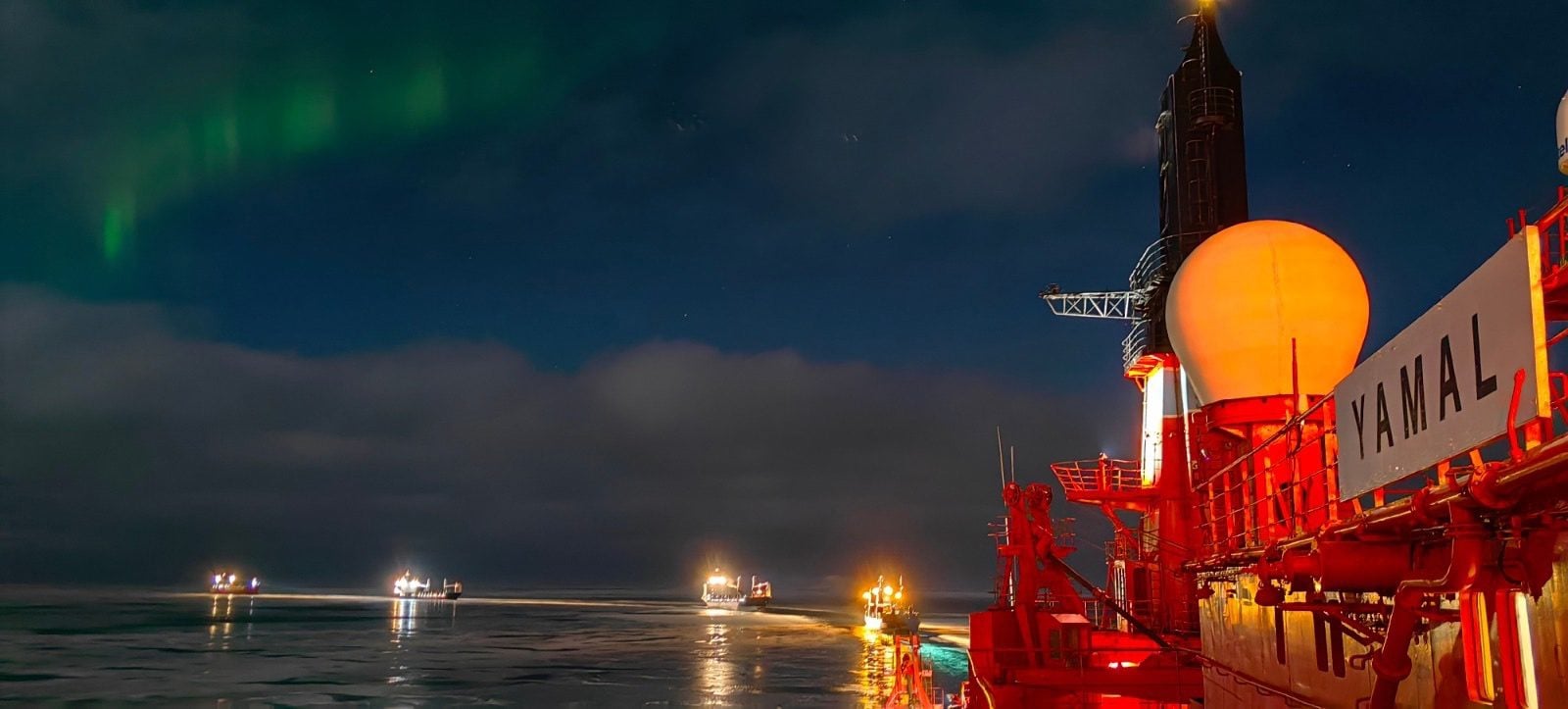
Commercial transits through Russia’s Northern Sea Route had exceeded the previous year’s total by the end of September, with oil tankers accounting for the largest cargo segment. According to gCaptain, the Centre for High North Logistics (CHNL) confirmed 104 voyages through 30 September 2026, against 103 across the full 2025 navigation season and 97 in 2024.
Estimated cargo carried on those transits reached 3.7 million tonnes, 15% above the 3.2 million tonnes recorded for all of 2025. The vessels’ combined deadweight tonnage stood at about 7.8 million tonnes, an increase of 26%. CHNL based its assessment on AIS information from MarineTraffic by Kpler. Its provisional outlook puts the final 2026 tally near 150 transits and above 4.5 million tonnes of cargo, with 45 possible additional voyages still under way or inside the route’s area at the September cut-off.
Tankers completed 22 eastbound voyages carrying an estimated 2.1 million tonnes, chiefly crude oil. Murmansk was the leading departure port, ahead of Primorsk and Ust-Luga. Bulk carriers made 13 eastbound passages with roughly 1.1 million tonnes of cargo, alongside 27 westbound voyages. Those westbound movements involved substantial repositioning towards the Baltic, Murmansk and other western destinations, illustrating the route’s use for transferring vessels between operating regions as well as transporting goods.
Container vessels accounted for 13 transits, including services linking Asian and European ports without a Russian endpoint. Four international Asia-Europe transits had finished by September’s end, compared with one throughout 2025. Examples included Panstar Acro travelling from South Korea to the United Kingdom, Dubai Tower arriving in the UK from China, and Riyadh Mukaab sailing from China to Felixstowe, gCaptain reported.
Ice conditions influenced vessel routing during the season. In early August, considerable traffic passed north of Severnaya Zemlya rather than through the customary Vilkitsky Strait passage. Improving conditions later that month allowed ships to return towards the usual route, with a more continuous open-water corridor emerging by early September. Open water remained beyond 30 September, offering better late-season navigation conditions than in 2024 and 2025. Seasonal freezing was nevertheless expected to begin progressively limiting access for vessels lacking ice-class capabilities from mid-October.